
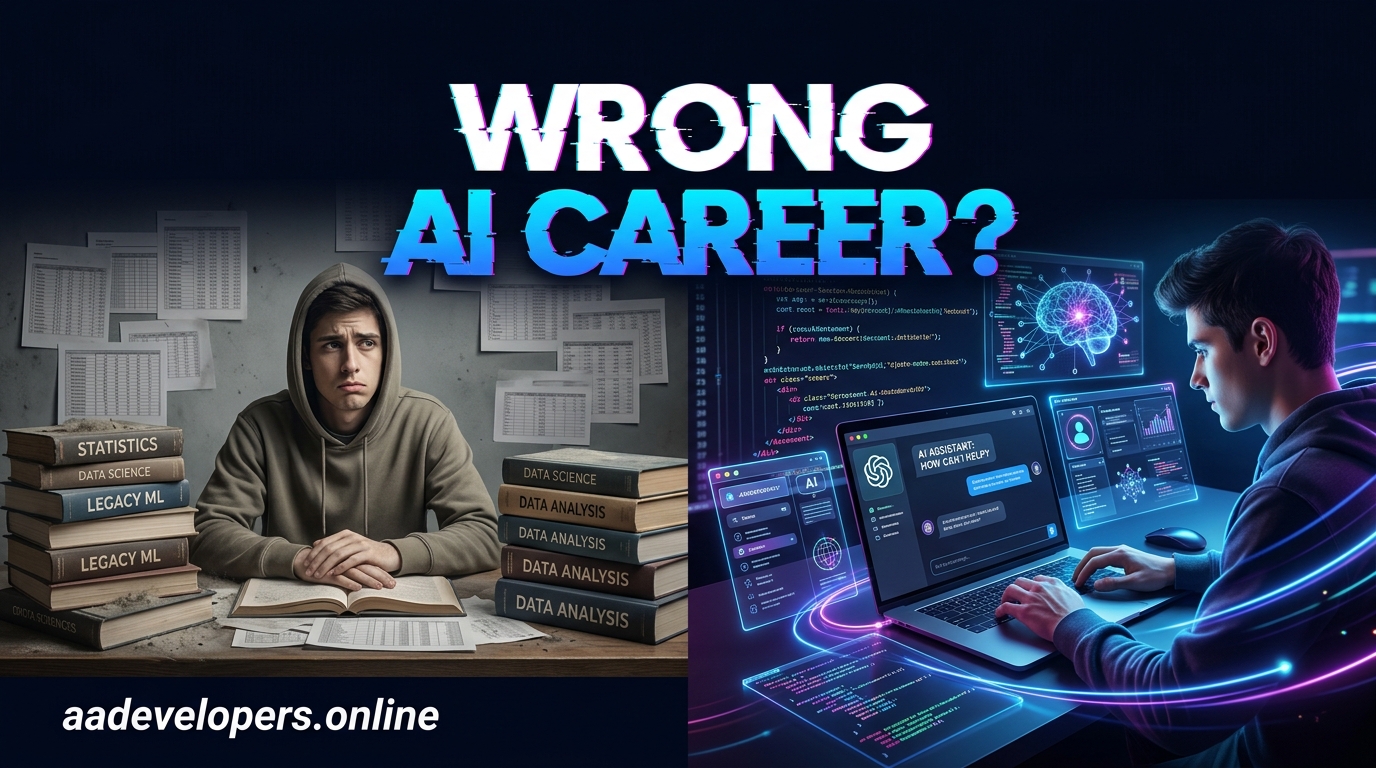
This might be an unpopular opinion, but I genuinely believe many students entering university in 2026 are preparing for yesterday's job market instead of tomorrow's.
Don't get me wrong — I don't think data science is useless. Without data science, modern AI wouldn't exist. Statistics, data cleaning, visualization, and analytics are still incredibly important foundations.
But the world has changed much faster than most universities — and students who don't recognize this shift risk spending four years mastering skills that AI tools are beginning to automate.
How ChatGPT Changed Everything
When ChatGPT was released, most people thought it was just another chatbot. It wasn't. It completely changed how software is built, how businesses operate, and crucially — what kinds of people companies need to hire.
Today, businesses don't just want someone who can analyze a spreadsheet. They want someone who can:
- Build an AI assistant that handles customer support at scale
- Automate complex business workflows using large language models
- Integrate AI into a production website or mobile application
- Create products powered by machine learning that generate real revenue
- Deploy and maintain AI systems in the cloud with proper MLOps practices
That's a completely different skill set from what's being taught in most data science programs — and the gap is widening every month.
"The fastest-growing AI roles in 2026 aren't 'data analyst.' They're 'AI engineer,' 'LLM product developer,' and 'ML platform engineer.' The curriculum hasn't caught up yet."
What I'm Actually Seeing in the Industry
I'm not writing this because I read one report or watched a YouTube video. I'm writing this because I've spent the last year building web applications, experimenting with AI tools, following model releases week by week, and watching where real hiring is moving.
Almost every week there's a new AI model. A new coding assistant. A new AI agent framework. A new deployment pattern. Everything is moving incredibly fast — and many university syllabuses are still teaching the same things they were teaching five or six years ago.
That's a serious problem for students who trust those syllabuses to prepare them for employment.
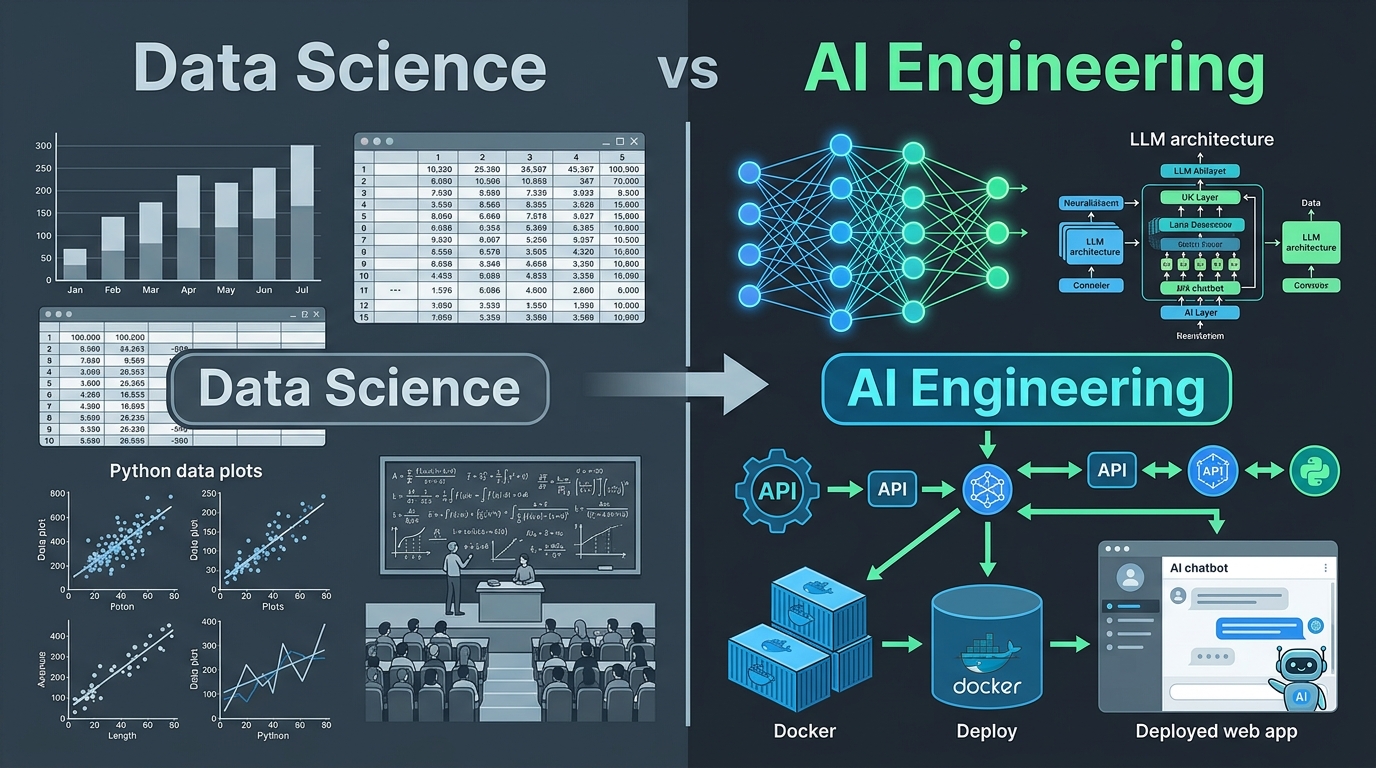
The Biggest Mistake Students Make
I think many students believe learning Python and a few machine learning libraries — scikit-learn, pandas, NumPy, maybe TensorFlow — is enough to land a strong AI job. It isn't.
The future isn't just about training models. The future is about building products with models. There's a massive difference. Ask yourself honestly:
- Can you build an AI-powered website from scratch?
- Can you deploy a trained model to production on AWS or Vercel?
- Can you connect a large language model to a real-world application via an API?
- Can you create an AI agent workflow that saves a company hours every day?
- Can you implement RAG (Retrieval-Augmented Generation) for a custom knowledge base?
Those are the questions employers are increasingly asking at interviews. If your answer is no, you're preparing for a market that is beginning to look a lot like yesterday.
The Shift from Data Analyst to AI Builder
The most valuable AI professionals in 2026 aren't those who can explain a regression coefficient on a dashboard. They're the ones who can ship an LLM-powered product in two weeks that a non-technical customer actually uses. The gap between these two profiles is where most students currently fall short.
Is Data Science Dead? The Honest Answer
No. And I don't think anyone should say it is.
But I do think the traditional data scientist role is being compressed and automated faster than anyone expected. The data scientist who mainly builds dashboards, runs A/B tests, and analyzes historical data will face increasing competition from:
- AI-powered analytics platforms (Tableau AI, Power BI Copilot, etc.) that generate insights automatically
- LLM coding assistants that help less technical people write their own queries
- Business intelligence tools that replace custom reporting work entirely
The data science professionals who will stand out by 2028 are those who can go beyond analysis — people who can build, deploy, and continuously improve intelligent systems that drive business outcomes.
What I'd Learn If I Were Starting in 2026
If I had to start from zero today, this is the exact sequence I'd follow to build the most future-proof AI career possible:
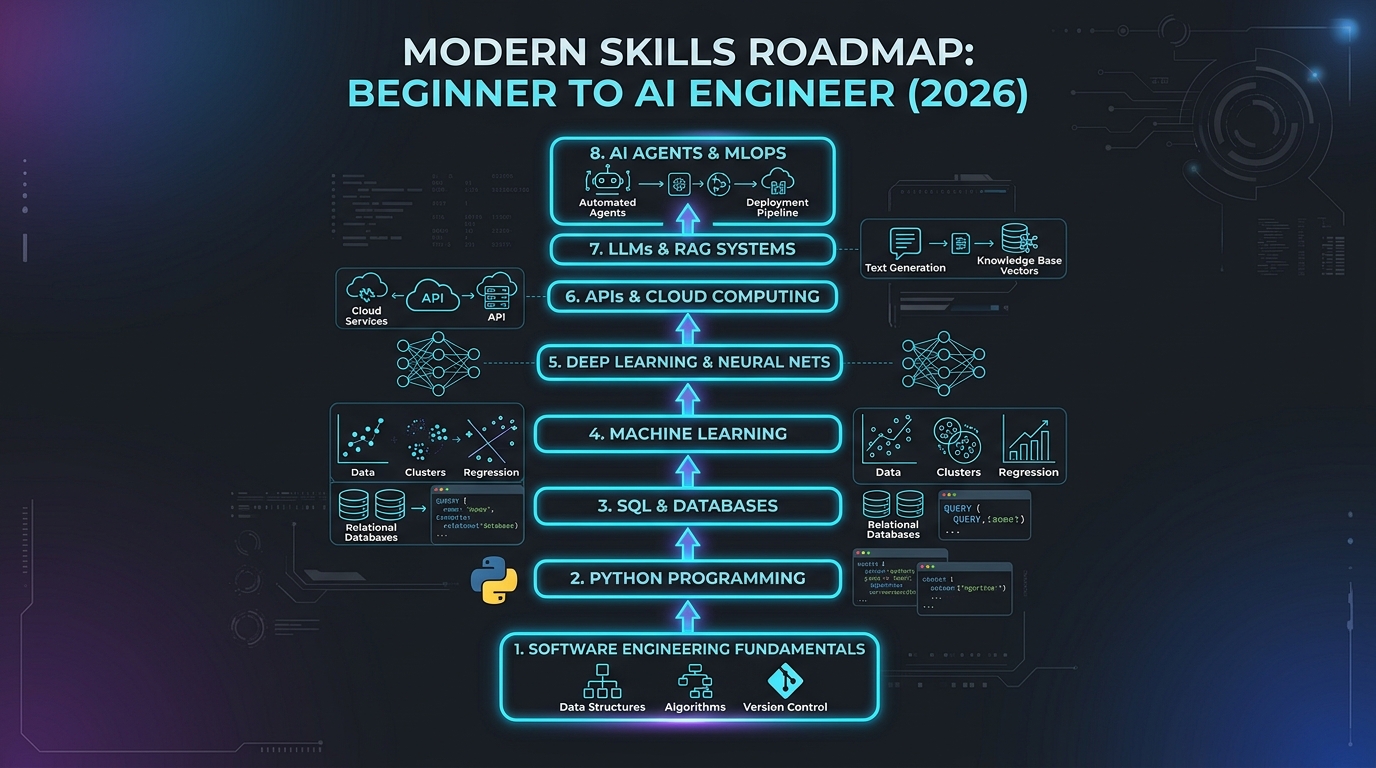
Software Engineering Fundamentals
Learn how software is actually built — version control, debugging, clean code, system design thinking.
Python Programming
The universal language of AI. Learn it deeply — not just syntax, but design patterns and performance.
SQL & Databases
Every real AI system interacts with data. Understand relational databases, indexing, and query optimization.
Machine Learning
Classical ML — regression, classification, clustering, evaluation metrics — still underpins everything.
Deep Learning & Neural Nets
Understand transformers, embeddings, and the architectures behind modern language models.
APIs & Cloud Computing
Build and consume APIs. Deploy on AWS, GCP, or Azure. Understand serverless and containerization.
LLMs, RAG & Agents
Use OpenAI, Gemini, and open-source models. Build RAG pipelines. Create autonomous AI agents.
Docker, Git & MLOps
Deploy models in production. Monitor drift, automate retraining, version models like software.
Why this order? Because AI is no longer a standalone feature — it's becoming the foundation of modern software. Students who understand both the software layer and the AI layer will always have an advantage over those who only know one side.
My Prediction for 2028
The Job Market Will Radically Restructure
By 2028, I believe we'll see significantly fewer job postings that focus solely on classical data analysis, and a substantial increase in roles that combine software engineering, machine learning, cloud infrastructure, and applied AI. Companies won't just ask: "Can you analyze our data?" They'll ask: "Can you build something with AI that solves this specific business problem — and ship it in production?"
The professionals who will command the highest salaries won't be the ones who completed the most online courses. They'll be the ones with deployed projects, open-source contributions, and a portfolio of real AI systems that real businesses relied on.
One Piece of Advice for Students in 2026
If you're choosing a career path today, don't chase what was popular five years ago. The safest bet is to:
- Learn the fundamentals hard — statistics, data structures, algorithms, and systems thinking will never expire
- Build real projects — not just Kaggle notebooks, but actual applications you could show to a potential client
- Experiment with AI tools weekly — the landscape changes so fast that curiosity itself becomes a career skill
- Combine software + ML — the strongest profiles in the market are full-stack AI engineers, not pure data analysts
- Ship and break things — the fastest learners are the ones who ship imperfect products and improve them in public
"Technology doesn't wait for anyone. The students who stay curious and keep building will always have an advantage — regardless of which AI model is currently trending."
This is just my perspective based on what I'm seeing in the industry today. Whether AI engineering becomes the dominant career path or data science reinvents itself into something I haven't anticipated — the students who are already building will be first in line either way.
Frequently Asked Questions
Is data science dead in 2026?
Data science is not dead, but the role is rapidly evolving. Traditional data scientists focused solely on dashboards and historical analysis face increasing automation from AI-powered analytics tools. The professionals who stand out combine data skills with software engineering, LLMs, and AI product development.
Should I learn data science or AI engineering in 2026?
AI engineering — which encompasses software development, Python, SQL, machine learning, cloud computing, LLMs, and RAG systems — offers broader and more future-proof opportunities than traditional data science alone. Combining both disciplines gives the strongest career foundation.
What is the best AI career path to learn in 2026?
The recommended path is: Software Engineering Fundamentals → Python → SQL → Machine Learning → Deep Learning → APIs & Cloud → LLMs & RAG Systems → Docker, Git & MLOps. Building real, deployable products at each stage is the key differentiator employers look for.
What will AI jobs look like in 2028?
By 2028, the dominant AI roles will combine software engineering, machine learning, cloud infrastructure, and AI product development. Employers will prioritize candidates who can deploy and maintain intelligent systems, not just analyze historical datasets.
Is AI engineering a good career in Pakistan?
Yes — AI engineering is one of the fastest-growing freelance and remote career paths for Pakistani developers. Companies in North America, Europe, and the Gulf increasingly hire remote Pakistani engineers for AI integration, web development with AI features, and LLM-based product development.
Want to Build Real AI Products?
Join our hands-on web development academy in Lahore. No boring lectures — you'll write real code and work on actual client projects from day one.
Apply for Free → Academy